
Our principles

25.06.2020

Raina Avramova and Eng. Dimitar Andreev alerted the Supreme Bar Council with a request to refer the matter to the Constitutional Court

The creation, provided for in the Legal Aid Act, of an information system for recording legal aid electronically for all bar councils solely by the National Legal Aid Bureau contradicts the Constitution. This opinion is expressed by the Sofia attorney Raina Avramova and Eng. Dimitar Andreev - manager of the company "BISOFT" EOOD, who have alerted the Supreme Bar Council (SBC) with a request to refer the matter to the Constitutional Court. Attorney Avramova and Eng. Andreev recall that the provision of Art. 18(4) of the Constitution provides for the possibility of establishing by law a state monopoly over a few exhaustively listed spheres of socio-economic relations, namely - rail transport, national postal and telecommunications networks, the use of nuclear energy, the production of radioactive products, weapons, explosives and biologically potent substances. Neither the activity of creating information systems as a whole, nor separate parts of them, are mentioned in the constitutional provision. A state monopoly is a situation in which, by law, the exclusive right to carry out a certain type of economic activity is granted only to state enterprises. According to them, however, in this case Art. 8a of the Legal Aid Act introduces a de facto monopoly position over the creation of an information system for recording legal aid electronically by all bar councils. "The provision of Art. 18(4) of the Constitution is an exception to the general principle of free economic initiative provided for in Art. 19(1) and to the principle of guaranteeing equal legal conditions for economic activity to all citizens and legal entities provided for in Art. 19(2) of the Constitution. Art. 18(4) of the Constitution cannot be interpreted extensively. The legislator has no power, beyond the exhaustively listed hypotheses in the provision, to grant an exclusive right to carry out economic activity to a specific state legal entity," Attorney Avramova and Eng. Andreev write to the SBC. "Therefore, through the general rule of Art. 8a of the Legal Aid Act, further developed in paragraph 13 of the TFP of the Act Amending the Legal Aid Act, according to which the state legal entity "National Legal Aid Bureau" remains the only legal entity that can create an information system for recording legal aid electronically, the legislator has created an unconstitutional legal situation of a complete state monopoly in an area that does not fall within the scope of Art. 18(4) of the Constitution," they also say. According to Attorney Avramova and Eng. Andreev, moreover, giving the National Legal Aid Bureau the opportunity to become a monopolist in building the information system restricts the right to economic activity, treats investors in the different types of information systems unequally and contradicts the principles of the rule of law and a number of other provisions of the Constitution. "The Bulgarian legal profession is called upon to defend the rights and legitimate interests of citizens and legal entities by virtue of Art. 134 of the Constitution. As its body, the Supreme Bar Council is in turn empowered by Art. 150(4) of the Constitution to refer to the Constitutional Court a request to exercise its constitutional power under Art. 149(1), item 2 to rule on the unconstitutionality of a law that affects the rights and legitimate interests of citizens. The contested provisions bar any legal entity, except the state in the person of the "National Legal Aid Bureau", from creating an information system for recording legal aid electronically, and prevent the bar councils from carrying out their activity of recording legal aid electronically within their autonomy, independence and self-government," they also write to the SBC. You can view the whole article here: Attorney and businessman: The possibility of building an information system for recording legal aid electronically solely by the Legal Aid Bureau contradicts the Constitution

Read at the source →

25.06.2020

Attorney Raina Avramova and Eng. Dimitar Andreev, manager of the software company Bisoft EOOD, have turned with a request to the chair of the Supreme Bar Council Ralitsa Negentsova to refer the Constitutional Court on two texts of the Legal Aid Act. These are the provisions of Art. 8a and paragraph 13 of the transitional and final provisions of the law, which oblige the bar councils, two years after its entry into force, to record legal aid and use for exchange of information only through the single information system for recording legal aid.

"The legislative solution is unconstitutional because it introduces an inadmissible monopoly position over the creation of an information system for recording legal aid electronically by all bar councils, since it grants this right exclusively to the state in the person of the "National Legal Aid Bureau" and does not allow this type of economic activity to be carried out by any other legal entity under any other possible legal conditions," the request says. Its authors remind that according to the Constitution a monopoly position is created only in expressly listed cases - rail transport, national postal and telecommunications networks, the use of nuclear energy, the production of radioactive products, weapons, explosives and biologically potent substances, among which information systems are not included. "By empowering a single state legal entity "National Legal Aid Bureau", in contradiction with Art. 18(4) in conjunction with Art. 4(1) of the Constitution, to act as "the state", the legislator allows the state to interfere unilaterally in the market for creating information systems for recording legal aid - "once as a bearer of public authority and once again as a specific state enterprise, which is the sole creator of the information system for recording legal aid electronically"," the authors say. This is also an abuse of right and creates a dangerous precedent, by virtue of which the state can unilaterally carve out a monopoly over any economic sector, which contradicts the democratic state governed by the rule of law, functioning under market economy conditions, they believe. "By reserving the carrying out of a certain economic activity solely to the state and pointing to the specific enterprise, the legislator places this enterprise in a privileged position vis-a-vis all other economic entities, in contradiction with the requirement of Art. 19(2) of the Constitution for creating equal legal conditions." The provisions also permit interference in the activity of the legal profession, which under the constitution is free, independent and self-governing, while the organisation and procedure of the legal profession's activity are regulated by law. The bar councils are placed in the impossibility of carrying out their activity of recording legal aid electronically freely, because the state ultimately imposes on them how to do it - without reasons and in conflict with the Constitution, the authors of the request say. They are categorical that the legislative provisions are also in violation of the principle of the rule of law, because they lead to "the compulsory removal, on an entirely new legal basis, of rights already acquired by economic entities on the basis of contracts concluded with the bar councils in the country for the use and maintenance of information systems for recording legal aid electronically. All this has happened "through sudden, unargued legislative amendments, without an in-depth assessment of the consequences, without observing the procedural order for adopting a legislative change and without public discussion, contrary to the formed legal expectations of economic entities, is incompatible with the rule of law"." You can view the whole article here: Request: The Supreme Bar Council to refer the Constitutional Court to unconstitutional provisions in the Legal Aid Act

Read at the source →

27.03.2020

On 24 March, at a press conference at the Council of Ministers, at which the government's economic ...

On 24 March, at a press conference at the Council of Ministers, at which the government's economic and social measures to combat the consequences of COVID-19 were announced, Minister Goranov in practice called nearly 1 million Bulgarians in the liberal professions and self-insured persons "marginals", and on this basis they were left outside the package of economic measures. Proceeding from the etymology of the word "marginal person", it follows that all these Bulgarian citizens are outside the measures because they find themselves on the border of different social groups, systems, cultures and under the influence of conflicting norms, values, etc. And all this in contradiction with the law, the Constitution of the Republic of Bulgaria and the position of the European Commission that, in this unprecedented situation, measures need to be taken to reduce the impact on employment, supporting not only persons employed under an employment contract but also the self-employed. More on the topic: Attorney: The state must also support the self-employed

Read at the source →

08.01.2020

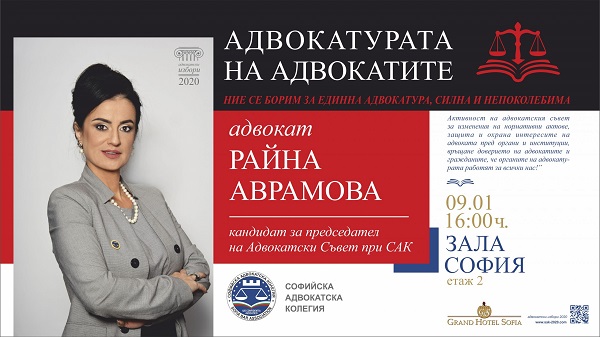
On 09.01.2020 (Thursday), at 4:00 pm in the "Grand Hotel Sofia", Sofia Hall, an official press conference will be held, in four panels:

DEAR LADIES AND GENTLEMEN ATTORNEYS, On 09.01.2020 (Thursday), at 4:00 pm in the "Grand Hotel Sofia", Sofia Hall, an official press conference will be held, in four panels: First panel: Presentation of the candidates for bodies of the Sofia Bar Association (SBA) who will take part in the elections scheduled for 25.01.-26.01.2020, included in the list of the candidate for Chair of the Bar Council of the Sofia Bar Association - Attorney Raina Avramova. Second panel: Presentation of a management programme for the Sofia Bar Association. Third panel: Statements by the individual candidates for SBA bodies on issues included in the SBA management programme. Fourth panel: Discussion of the presented programme. Closing part: Cocktail. The total duration of the press conference is four astronomical hours. You are welcome! We will be glad to see you! SBA Elections 2020

Read at the source →

Page 5 of 16